
Get Slidell & St. Tammany News
Enter your email below to get local news in your inbox.

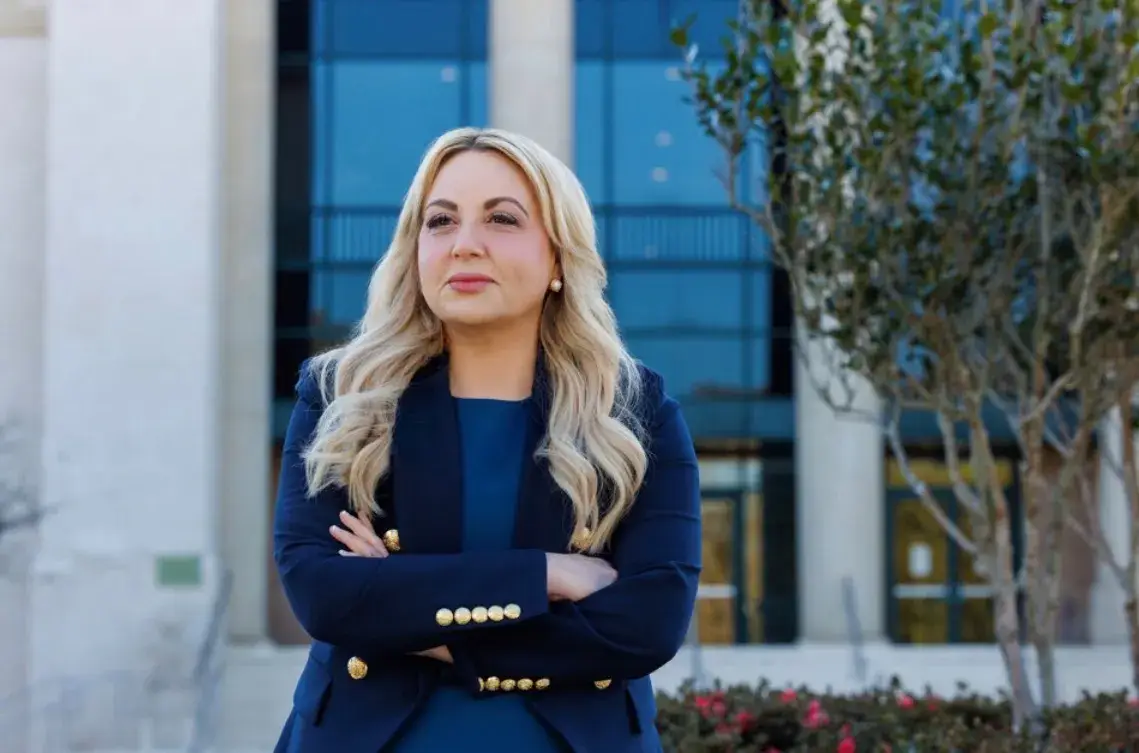
MANDEVILLE, La. — Angelina Valuri’s path to becoming a candidate for District Court Judge in Division G started long before she became an attorney. It began when she was 18 years old, fresh out of high school, and decided to enter a police academy after years of conversations with law enforcement officers who frequented the 24-hour cafe where she worked.
Nearly three decades later, Valuri says the experiences that followed have shaped both the person she is today and the kind of judge she hopes to become.
Valuri, 48, is a Mandeville resident who moved to St. Tammany Parish in 2012. She describes herself as a wife, Christian, conservative, longtime public servant and someone deeply committed to public safety.
During a sit-down interview with The Rabbit Hole, Valuri spoke extensively about the parts of her life that do not necessarily fit neatly onto a campaign sign or résumé.
“I’m someone who cares deeply about this community,” Valuri said. “Even though I did not grow up here, Louisiana is my home.”
An Unexpected Beginning In Law Enforcement
Valuri graduated from high school in Florida in 1996.
During high school, she worked at a 24-hour cafe where police officers and other law enforcement personnel regularly stopped during their shifts. Valuri said the officers would come inside to write reports, get a cup of coffee and spend some time out of the weather.
She had no relatives in law enforcement, but the conversations caught her attention.
Valuri became interested in the arrests officers were making, the investigations they were conducting and the work they were doing in the community.
Eventually, one of those officers asked if she had ever considered enrolling in a police academy.
She hadn’t.
But she followed his suggestion and spoke with a recruiter.
Valuri graduated high school in May 1996 and entered the academy in January 1997 at just 18 years old.
“I went through the academy thinking I was going to try this out to see if I liked it,” Valuri said. “I ended up falling in love with it.”
After graduating from the academy, Valuri went to work in law enforcement. She spent five years with the Alachua County Sheriff’s Office before spending the majority of her career with the Gainesville Police Department.
Altogether, she spent 13 years in law enforcement.
A Career That Shaped Her View Of Victims
Valuri still remembers her first arrest.
It involved domestic violence.
Domestic violence would become something she encountered repeatedly throughout her law enforcement career, and Valuri said those experiences left a lasting impression.
“People don’t realize how prevalent domestic violence is,” she said. “It’s something that affects all walks of life, all different types of families.”
Valuri said supporting victims and survivors became particularly important to her.
She believes survivors need to know there is a path out of abusive situations and that support can be critical as they attempt to rebuild their lives and establish healthy relationships for themselves and their children.
That concern for victims would eventually follow Valuri into another profession.
Moving To St. Tammany And Starting Over
Valuri moved to St. Tammany Parish in December 2012 and married her husband in January 2013.
At that point, she had already spent years in law enforcement, but she did not want to simply restart her law enforcement career in a new state.
Instead, she decided to pursue another role in the justice system.
She went to law school.
Valuri entered LSU Law in her mid-30s and said there was never much uncertainty about what she wanted to do with the degree.
“I did not go to law school to become an attorney,” Valuri said. “I went to law school specifically to become a prosecutor.”
She graduated from LSU Law in 2016 and began her legal career as an assistant district attorney in Orleans Parish.
Valuri said she worked her way from magistrate court to misdemeanor cases before eventually becoming a senior felony attorney responsible for her own section of court.
In late 2018, she interviewed with then-District Attorney Warren Montgomery and was hired as a felony prosecutor in the 22nd Judicial District.
She has spent years trying cases in the same judicial district where she is now asking voters to elect her to the bench.
From The 911 Call To The Courtroom
One of the experiences Valuri believes is important to understanding her career is that she has participated in the criminal justice system from several different positions.
She has been the officer responding to the initial 911 call.
She has been the investigator developing a case.
She has been the prosecutor presenting that case in court.
She has stood before juries.
And she has worked directly with victims whose lives were affected by the crimes being prosecuted.
“I’ve been the officer who has responded to 911,” Valuri said. “I have been the investigator, the detective who has investigated the case. I’ve been the prosecutor who’s tried the case.”
Valuri refers to that as seeing the “full arc” of a criminal case.
During her time in the 22nd JDC, Valuri said she has practiced before eight of the court’s ten general-jurisdiction judges and has been responsible for significant felony caseloads.
She said supervisors have referred to her as a “force multiplier,” bringing her into divisions where keeping cases moving and controlling the size of the docket were priorities.
That experience is central to one of the primary issues she talks about as a candidate: judicial efficiency.
Keeping Cases Moving Without Sacrificing Justice
Valuri said she wants voters to understand that an efficient court is not simply a court that disposes of cases quickly.
For her, the objective is to keep cases moving while making sure they receive the attention they deserve.
She said the outcome could be a jury trial, a plea agreement or, on the civil side, a settlement. What matters is that cases continue progressing through the system.
Valuri estimated there are currently more than 3,100 pending felony docketed cases in the district.
She also explained that the amount of time actually available for jury trials is limited.
According to Valuri, the court calendar currently provides 10 weeks each year for criminal jury trials and four weeks for civil jury trials, with the civil weeks divided between St. Tammany and Washington parishes.
The remainder of the court calendar includes motion hearings, pretrial conferences and the other work necessary to move cases toward resolution.
That is one reason Valuri believes the public should better understand plea agreements.
“If we tried every single case, civil or criminal, that’s pending on our dockets currently, the judicial system would come to a screeching halt,” she said.
Valuri said plea agreements are sometimes viewed by the public as an indication that a defendant escaped consequences.
She believes that view misses much of what happens behind the scenes.
Valuri said prosecutors consider a defendant’s criminal history, the circumstances of the case and the wishes of victims. In some cases, she said, victims themselves do not want to testify before a jury and relive one of the most traumatic experiences of their lives.
“Plea agreements should not be looked at, or those should not be dirty words in the eyes of a voter,” Valuri said.
She sees them as one of several tools available to move cases toward a resolution while still pursuing justice.
When The Cases Become Personal
A career in law enforcement and felony prosecution has also exposed Valuri to some of the darkest cases that enter the justice system.
She has handled cases involving murder and the sexual abuse of children.
Asked whether she is able to prevent those cases from following her home emotionally, Valuri did not pretend they simply disappear when she leaves the courthouse.
“If I were to sit here and tell you I just turn it off like a light switch, that would not be the truth,” she said.
Valuri said her years in law enforcement taught her that people working around trauma need healthy ways to manage stress.
She credits her family and friends with providing a strong support system and said she makes a conscious effort to maintain a life outside of her work.
But difficult cases can also produce some of the moments she remembers most.
Valuri said victims have remained in contact with her years after their cases were resolved.
One case involved a young victim of a child sex crime. The case took years to reach trial, and by the time it did, the victim had become a teenager and moved out of Louisiana.
Valuri said the defendant was ultimately convicted.
Later, Valuri bought a plane ticket with her own money and traveled to Florida to watch the young woman graduate from high school.
Valuri said she had invested so much of herself into the case and into helping the young woman that the two developed a friendship she believes will last a lifetime.
It is also an example, she said, of the side of her career her husband has seen that most people never do.
The late nights. The weekends. The missed family functions. The preparation. The frustration. And sometimes the tears.
“He sees behind the curtain,” Valuri said.
A Different Side Of Her Career
Valuri’s résumé has not been limited to law enforcement and criminal prosecution.
She also spent time as a civil litigator with the Truitt Law Firm, where she said she handled insurance defense, contract law and some personal injury work.
Then, for a period, she stopped practicing law altogether.
Valuri became a small business owner.
She opened SNACX Charcuterie and operated out of a kitchen in downtown Covington, directly across from the courthouse.
Valuri described the business as successful and said it received recognition as one of the top women-owned businesses in St. Tammany Parish. She also said SNACX became the first St. Tammany business to have a contract with the Saenger Theater in New Orleans.
But one part of the business connected directly back to experiences from her law enforcement career.
Valuri created a program called “Stronger Than a Board,” through which leftover food was donated to Safe Harbor for women and children displaced from their homes because of domestic violence.
Valuri said she probably would have continued operating the business had Montgomery not died.
After his death, she said District Attorney Collin Sims approached her about returning to the District Attorney’s Office.
She agreed and returned to felony prosecution.
Accountability And Second Chances
Throughout the interview, Valuri repeatedly returned to two concepts that can sometimes appear to conflict: accountability and understanding.
She does not believe they have to.
Valuri said she believes people should be held responsible for their actions, particularly when their actions harm someone else.
But she also believes every person arrives in a courtroom with a different life story.
“We do not live in the land of black and white,” Valuri said. “We live in the land of the gray.”
People come from different backgrounds, families and circumstances, she said, and those differences matter.
That does not mean ignoring the crime.
Valuri said judges have to consider the offense, the harm caused, a person’s criminal history and the circumstances that contributed to the behavior.
“I think it is possible to be tough on crime, but also understand that everybody has a story,” she said.
That philosophy is one reason Valuri strongly supports specialty courts.
She pointed to programs serving people whose criminal behavior may be connected to substance abuse, mental health issues or experiences related to military service.
Valuri said she has personally seen people transform their lives after participating in those programs.
She estimated that when she encounters a felony defendant in court, there is roughly a 50 percent chance that person will eventually return to a felony docket. For defendants who successfully graduate from specialty court programs, she said that figure drops to around 20 percent.
Valuri made clear those were rough numbers, but said the difference illustrates why she believes the programs matter.
“You’re preventing reoffenders,” she said.
She recalled working in a division that included reentry court and watching participants change their lives.
For Valuri, those outcomes are another side of justice.
The Woman Outside The Courthouse
Valuri has been married since 2013.
Her husband is a radiologist, and Valuri describes him as one of the most important parts of the support system that has allowed her to handle the demands of her career.
The couple does not have children.
They do have two tuxedo cats, both 14 years old.
Valuri said she and her husband are longtime supporters of the Humane Society and donate monthly.
She enjoys traveling and spending time with her husband, and her faith is also an important part of her life. Valuri described herself as a Christian and later shared that she is Catholic.
She also describes herself as someone who has difficulty seeing another person in need without wanting to help.
“If I have it, it’s yours,” Valuri said.
Those personal beliefs also influence how she views people who come before the justice system.
She believes in forgiveness. She believes people make mistakes. And she believes mercy and accountability can exist at the same time.
Why Angelina Valuri Is Running
Valuri left the District Attorney’s Office on May 1 to become a full-time candidate.
She describes her campaign as being centered around two priorities: keeping the Northshore safe and improving judicial efficiency.
But underneath those campaign themes is a career that has taken an unusual path.
Valuri has worn a badge.
She has investigated crimes.
She went back to school in her mid-30s because she specifically wanted to become a prosecutor.
She has practiced civil law.
She has owned a local business.
She has worked with domestic violence survivors.
She has prosecuted some of the most serious crimes that enter a courtroom.
And she has watched defendants change their lives through programs designed to address some of the problems contributing to their criminal behavior.
Valuri said public service attorneys do not choose the work because they expect to become wealthy. She described prosecutors as some of the lower-paid attorneys in the profession and said the hours and emotional toll require someone to have a genuine passion for the work.
For her, the reward has been representing victims.
“It’s been my honor, quite frankly, to be in court representing victims every single day,” Valuri said.
She said victims need to know they are seen, heard and valued, and that the justice system has an interest in holding people accountable when they harm others.
For Valuri, the experiences of the past three decades have also reinforced a belief that justice requires more than simply being tough or lenient.
It requires understanding the case and the person standing in front of you.
She also believes character matters alongside qualifications for someone seeking a seat on the bench.
“I believe that it’s important for people to be honest, and I also believe it’s important that people be held accountable for their actions,” Valuri said. “It doesn’t mean that I don’t have mercy in my heart. It does not mean that I don’t understand people make mistakes.”
After 13 years in law enforcement, law school in her mid-30s, work in criminal and civil law, ownership of a Covington small business and years prosecuting felony cases in the 22nd Judicial District, Valuri is now asking voters to consider that entire path as she seeks the Division G seat on the 22nd Judicial District Court.
For voters getting to know Angelina Valuri for the first time, her conversation with The Rabbit Hole offered a look beyond the campaign and into the experiences, career and personal convictions that have shaped the candidate she is today.




What do you think about this decision? What should local officials do next?
Free. Straight to your inbox. Cancel anytime.




Join the conversation — create a free TRH News account to comment.