
Get Slidell & St. Tammany News
Enter your email below to get local news in your inbox.

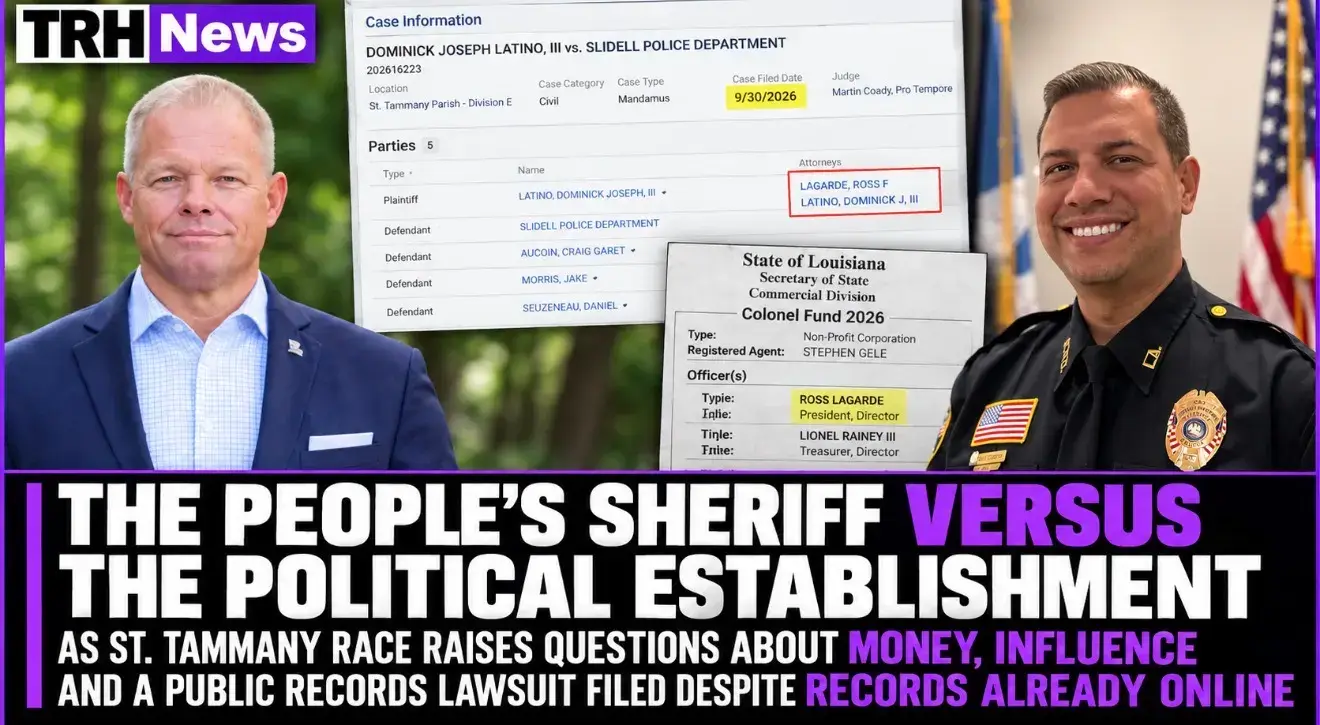
ST. TAMMANY PARISH, La. — The race for St. Tammany Parish sheriff is becoming more than a contest between candidates. It is raising questions about political influence, campaign financing and whether the backing of powerful political interests will determine who leads one of Louisiana’s most important local law enforcement agencies.
At the center of the latest controversy is a public records lawsuit involving sheriff candidate Daniel Seuzeneau and the Slidell Police Department. Court records reveal a connection between an attorney associated with that lawsuit and a political fundraising organization tied to the campaign of Robert Hodges.
But another question surrounding the lawsuit may be just as significant. Were the requested records already available online before the lawsuit was filed?
Together, these circumstances are adding fuel to an emerging political narrative in St. Tammany Parish: the people’s sheriff versus the political establishment’s choice.
The Lawsuit And The Records Already Online
On September 30, 2026, a civil mandamus action was filed involving the Slidell Police Department, Seuzeneau, Sgt. Jake Morris and Lt. Craig Aucoin.
The lawsuit concerns a public records request seeking information involving Seuzeneau’s law enforcement career.
According to an account of the department’s handling of the request, the Slidell Police Department advised that it needed 14 business days to respond to a request involving records spanning approximately two decades.
However, the lawsuit was reportedly filed on the ninth day, before that response period had elapsed.
More significantly, the same account maintains that responsive documents had already been uploaded to the department’s online public records portal by the time litigation was initiated.
If confirmed by the department’s production logs and correspondence, that sequence raises a legitimate question.
Why file a lawsuit seeking access to records that had already been made available?
The distinction is important. A public agency can still face legitimate legal challenges if its production is incomplete, access is inadequate or other obligations under Louisiana’s Public Records Law remain unresolved.
The available materials do not independently establish whether every requested document had been produced, when the requesting party was notified or whether outstanding legal issues remained.
Nevertheless, the reported timeline deserves closer examination, particularly given the proximity of the election.
Public records laws exist to promote transparency and accountability. They should be applied fairly, regardless of whether the person requesting information supports or opposes a political candidate.
But if the records were already available, the decision to pursue litigation warrants an explanation.
The Attorney Connection
The court docket identifies attorneys Dominick J. Latino III and Ross F. Lagarde in connection with the plaintiff.
Lagarde’s name also appears in Louisiana Secretary of State corporate records for Colonel Fund 2026, where he is listed as president and director.
Colonel Fund 2026 is a joint fundraising organization associated with Hodges for Sheriff, Inc. and Protect St. Tammany’s Future, Inc.
The corporate filing also identifies Lionel Rainey III as treasurer and director.
This creates a documented overlap between an attorney associated with litigation involving Seuzeneau and a political fundraising organization connected to Hodges’ campaign.
That overlap does not establish that Hodges, his campaign or the fundraising organization directed the lawsuit.
It does, however, raise questions about the relationships between the individuals involved and whether any political interests played a role in the litigation.
Those questions are especially relevant when a lawsuit involving one candidate emerges during the final weeks of an election campaign.
The Money Behind The Election
Colonel Fund 2026 was established through a joint fundraising agreement effective August 3, 2026.
The arrangement involves Hodges for Sheriff, Inc. and Protect St. Tammany’s Future, Inc., allowing participating organizations to solicit contributions through a shared fundraising structure.
Under the agreement’s stated allocation formula, an individual contributor may provide up to $100,000, with $24,000 allocated to the candidate’s campaign across the primary and general elections and $76,000 allocated to Protect St. Tammany’s Future.
Two qualifying contributors could potentially provide $200,000 combined.
The fundraising structure is authorized under Louisiana Revised Statute 18:1491.9, enacted through legislation passed during the 2025 legislative session.
The law permits qualifying joint fundraising arrangements, subject to applicable contribution limits, disclosure requirements and allocation rules.
There is nothing inherently illegal about using such an arrangement.
But the ability to collect six-figure contributions through a single fundraising operation represents a significant financial advantage in a local election.
For voters accustomed to seeing sheriff candidates campaign through community events, neighborhood visits and smaller donations, the scale of such fundraising can appear far removed from traditional grassroots politics.
And it raises a question worth asking.
At what point does a local sheriff’s election become less about the community and more about the financial and political interests backing a candidate?
The People’s Sheriff Versus The Political Establishment
Perhaps the most compelling contrast emerging from this election is not simply between Seuzeneau and Hodges, but between two very different images of political support.
Seuzeneau has built his public identity around decades of local law enforcement experience, community relationships and his connection to the people of St. Tammany Parish.
Hodges has attracted support from influential political figures and a fundraising network capable of bringing substantial financial resources into the race.
The contrast has helped create a powerful campaign narrative: the people’s sheriff versus the political establishment’s choice.
It is a political characterization, not proof that either candidate exclusively represents ordinary residents or wealthy interests. Both candidates must ultimately earn the confidence of voters.
Still, the contrast speaks to a larger issue.
The sheriff is not appointed by the governor. The office does not belong to political donors, political action committees or influential figures in Baton Rouge.
The sheriff is elected by the people of St. Tammany Parish and answers directly to them.
The position carries tremendous authority over public safety, law enforcement operations, personnel and taxpayer resources.
That makes the question of political influence particularly important.
Will St. Tammany’s next sheriff be chosen primarily on the strength of his relationship with the people he hopes to serve, or will the resources and influence of Louisiana’s political establishment prove decisive?
Why The Timing Matters
The lawsuit was filed September 30, approximately five weeks before the November 3 election.
Public records requests are legitimate tools for holding government accountable, and the right to pursue records through the courts is an essential part of government transparency.
Filing such a lawsuit during an election is not, by itself, evidence of political motivation.
But timing, professional relationships and the circumstances surrounding the records request are all relevant to understanding what happened.
If the department had already uploaded responsive documents before the lawsuit was filed, that fact would be important to the public’s understanding of the dispute.
Likewise, the involvement of an attorney who also holds a leadership position in a fundraising organization associated with the opposing candidate is a connection voters may reasonably want explained.
Neither circumstance independently proves political coordination.
But together, they present questions that deserve clear answers rather than speculation.
Where Political Fundraising And Independent Organizations Meet
Louisiana law distinguishes between candidate campaign committees, joint fundraising arrangements and independent political expenditures.
The state’s newer joint fundraising law permits certain political organizations to participate in shared fundraising operations.
At the same time, independent political spending remains subject to rules intended to prevent prohibited coordination with candidates and their campaigns.
Those distinctions matter.
The existence of a joint fundraising agreement does not automatically establish unlawful coordination, nor does the participation of attorneys or political supporters in multiple organizations prove wrongdoing.
Determining whether any laws were violated would require examination of campaign finance reports, expenditure records, organizational activities and other evidence.
But transparency should not depend on whether an arrangement is technically legal.
Voters have a legitimate interest in understanding who finances political campaigns, who controls the organizations supporting them and how those organizations operate.
That standard should apply equally to every candidate.
The Decision Belongs To St. Tammany
As Election Day approaches, the contrast between grassroots political support and institutional financial backing is becoming an important part of the sheriff’s race.
One candidate has emphasized his local law enforcement experience and community relationships. The other has attracted powerful political support and substantial fundraising opportunities.
Neither approach guarantees effective leadership.
Financial backing does not automatically make a candidate unqualified, just as grassroots popularity does not automatically make someone the best person for the job.
But the circumstances surrounding the lawsuit, the reported availability of the requested records and the documented fundraising connections raise questions that voters deserve to see examined.
The sheriff’s office belongs to the people of St. Tammany Parish.
Not the governor. Not the political organizations. Not the wealthy donors.
This election may ultimately become a test of whether community relationships and public trust can compete with the money and influence of Louisiana’s political establishment.
And regardless of how much money is raised, how many political endorsements are secured or how much influence is brought into the parish, one fact remains unchanged.
The people of St. Tammany Parish will choose their next sheriff.




What do you think about this decision? What should local officials do next?
Free. Straight to your inbox. Cancel anytime.





Join the conversation — create a free TRH News account to comment.