Newsletter Subscribe
Enter your email address below and subscribe to our newsletter

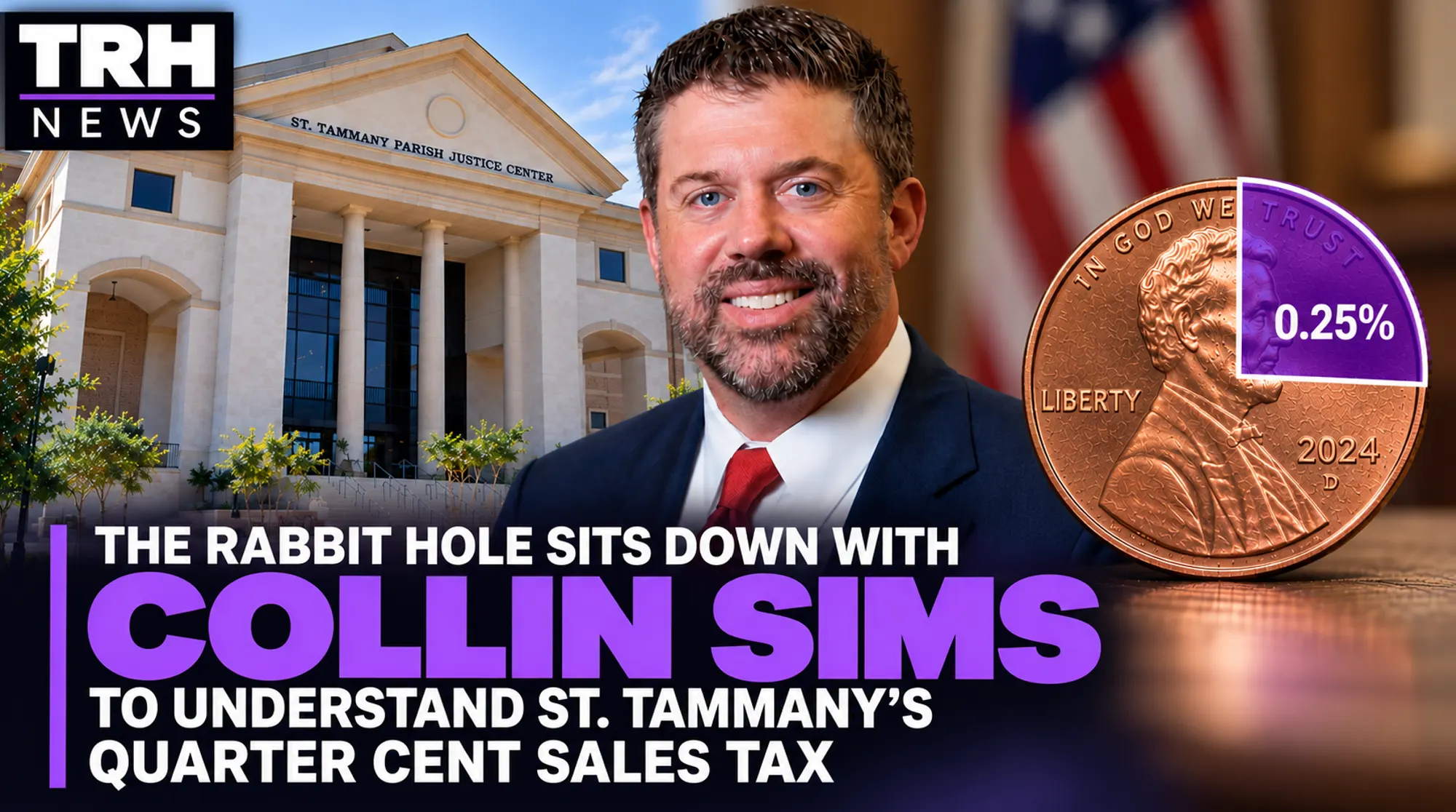
There has been a lot of talk about St. Tammany Parish’s proposed quarter cent sales tax. There have also been a lot of numbers thrown around, and that can make a relatively simple issue sound extremely complicated.
So The Rabbit Hole sat down with 22nd Judicial District Attorney Collin Sims and asked him to explain what is happening, why the justice system says it needs additional funding, and why parish government cannot simply take money it already collects and move it where it is needed.
This article is not going to tell you how to vote.
Instead, we are going to explain the issue in the simplest way possible.
This is the most important thing to understand.
Imagine you have $100.
But $40 is in an envelope marked groceries only.
Another $25 says electric bill only.
Another $20 says house payment only.
Another $10 says medicine only.
That leaves only $5 that you can spend wherever you need it.
You still have $100.
But you do not have $100 available to spend however you want.
That is basically how much of St. Tammany’s tax system works.
A large amount of the money collected through taxes is dedicated.
“Dedicated” simply means the voters approved that money for a particular purpose. Government generally cannot just take that money and use it for something completely different.
According to figures published by St. Tammany Parish Government, the parish’s 2024 property tax structure represented approximately $407.4 million across more than 63 property and ad valorem tax line items.
But after those dedicated uses are accounted for, the parish says only about $7.8 million is available to help fund core operations including the jail, District Attorney, judges, courthouse and parish government.
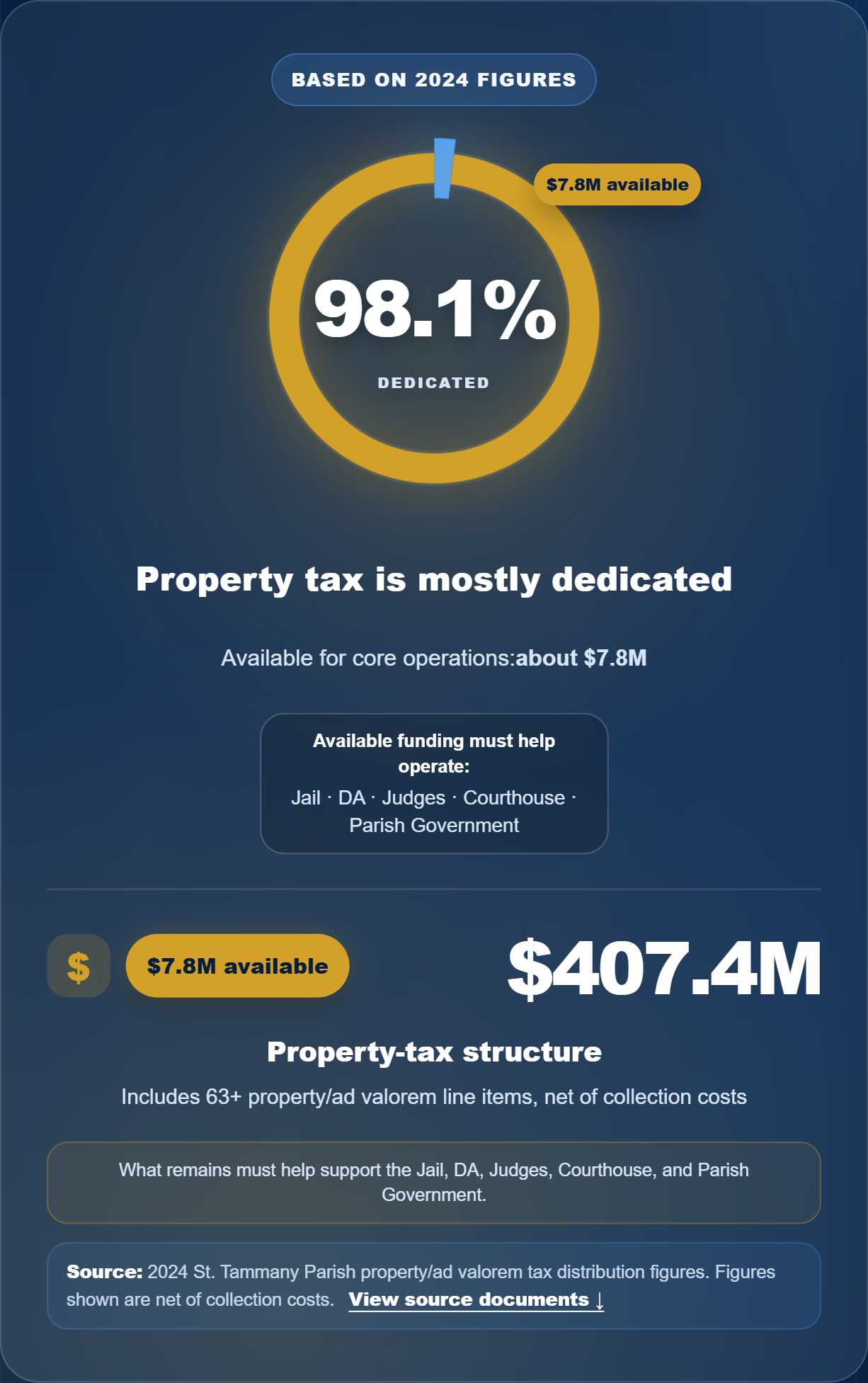
That is the first major piece of this puzzle.
When somebody hears that hundreds of millions of dollars in property taxes are collected, it is understandable to ask:
“Then why don’t they just use some of that money?”
Because most of it already has a legal destination.
It is money sitting in labeled envelopes.
Sims told The Rabbit Hole the problem has been building for years. He said the parish’s tax structure dates back to the 1980s, when St. Tammany moved from a police jury to its current parish form of government, and that it has not fundamentally changed since then.
He said some revenue sources that once helped cover these costs, including the jail and justice center tax, the public health millage and the coroner’s millage, are no longer available. By his estimate, that adds up to about $55 million a year.
Sims said that leaves a small parish general fund as the main legal source of money for the District Attorney’s criminal division, the jail, the justice center and the coroner’s office. He said that fund brings in about $16 million a year and falls about $18 million short of what those operations need each year.
The same problem exists with existing local sales taxes.
St. Tammany Parish Government’s published information shows approximately $316.7 million in local sales tax revenue using its 2024 comparison data.
That sounds like an enormous amount of available money.
Except the parish says the flexible portion available for general operations is:
$0.
Not because the money disappeared.
Not because nobody knows where it went.
The existing sales taxes are already dedicated to specific purposes.
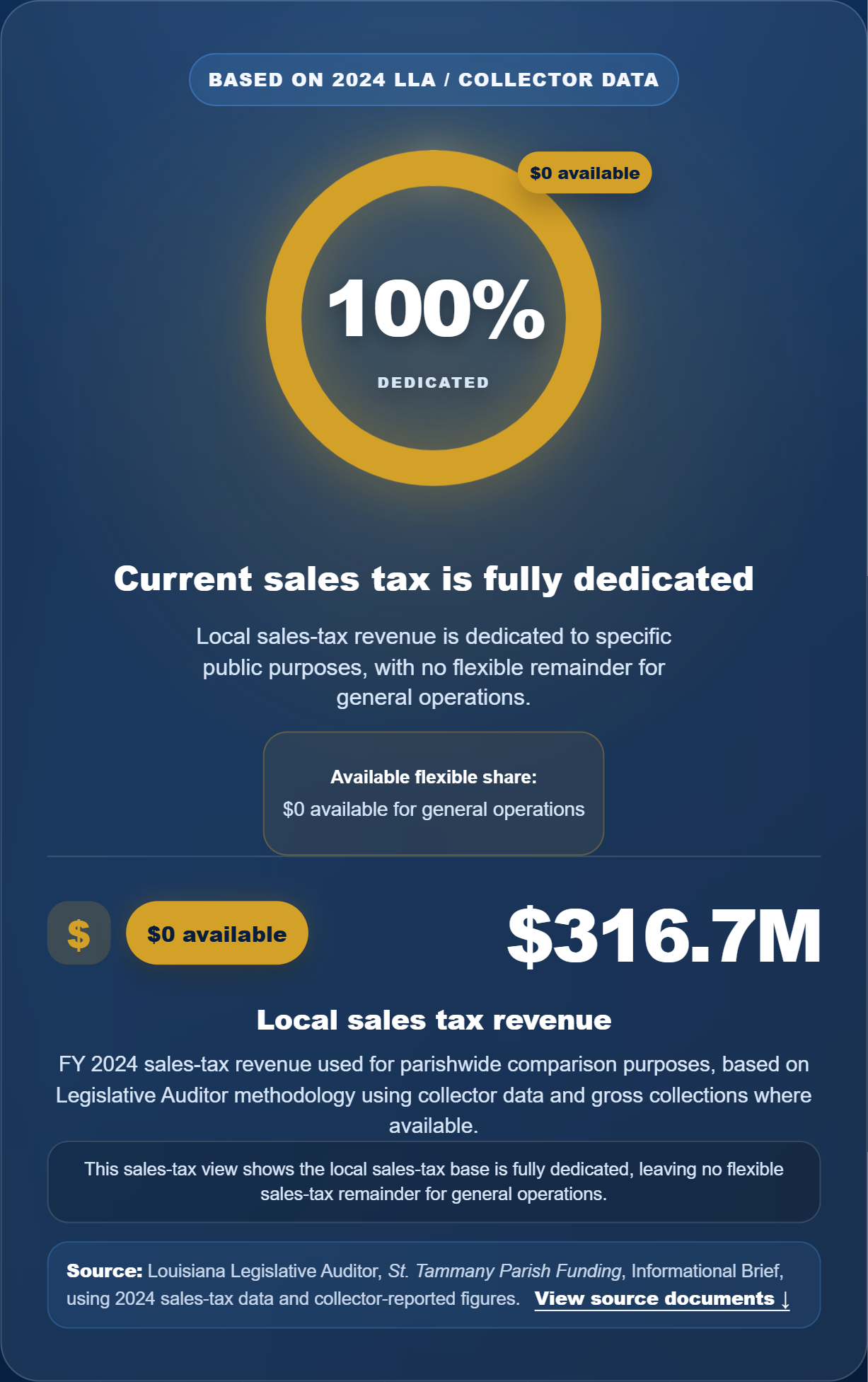
That is why simply saying “St. Tammany already collects hundreds of millions of dollars” does not explain the entire problem.
The better question is:
How much money does St. Tammany collect that can legally be used to pay these particular bills?
Those are two very different numbers.
This part is extremely simple.
A quarter cent sales tax is 0.25 percent.
It does not mean everything suddenly costs 25 percent more.
If you buy $20 worth of taxable goods, the additional tax is 5 cents.
Spend $100 and it is 25 cents.
Spend $500 and it is $1.25.
Spend $1,000 and it is $2.50.
What the proposal is: St. Tammany Parish Government describes it as a temporary 0.25 percent sales tax for five years. A parish council resolution on the proposal dedicates the money to criminal prosecution and court services, including the District Attorney’s Office, the 22nd Judicial District Courts, the Justice Center, the DNA Lab and the Coroner’s Office, and the parish jail.
How much it would raise: Sims told The Rabbit Hole that the estimates presented to him showed the tax generating approximately $18 million per year. Parish government’s own estimates are in the same range. Its Tax & Financial Future Plan page models about $17.9 million a year using 2024 numbers, and the council resolution estimated about $18.3 million a year.
What parish government says it will pair with the tax: Parish government’s plan page says local taxing agencies “would be asked to reduce millages” so the new sales tax can be offset by lower property tax collections, with a stated goal of a “net-neutral impact for residents.” The parish estimates that would take about 6.83 mills in reductions. Those millage reductions are described as requests to other agencies. They are not part of the sales tax resolution itself.
Sims said parish officials told him their calculation works out to roughly $60 a year per household, and that about 20 percent of the tax would be paid by people from outside the parish. Those are parish estimates as Sims relayed them. The Rabbit Hole has not independently verified them.
Sims also made an important distinction during our interview.
He is a recipient of parish funding. He does not control the parish government’s campaign or messaging surrounding the proposal.
“I’m a budget recipient,” Sims told The Rabbit Hole while discussing the proposal.
His concern is what happens to the District Attorney’s Office and the justice system if adequate funding is not available.
Sims told The Rabbit Hole that his office had approximately $9.7 million in total revenue in 2025.
But there is another important detail.
That is not $9.7 million just to operate in St. Tammany.
The 22nd Judicial District Attorney’s Office serves both St. Tammany and Washington parishes.
Sims said approximately $6.2 million came from St. Tammany Parish, approximately $1.5 million came from the state, approximately $1 million came from Washington Parish and roughly another $1 million was generated through sources including fines, fees and asset forfeiture.
Even some of that money has restrictions.
For example, Sims explained that state funding includes prosecutor “warrants.”
Each warrant provides $50,000.
But that money can only pay the salary of a prosecutor.
It cannot pay an investigator.
It cannot pay a secretary.
It cannot simply be moved somewhere else in the office.
Sims said that if the money is not spent on prosecutor salaries, it has to be sent back.
Sims said his office had 30 of those warrants for approximately 20 years before securing 14 additional warrants, bringing the total to 44.
He said that raises the state warrant funding from about $1.5 million to about $2.2 million a year. Because the new warrants started in July, he said this year reflects only about $1.8 million.
Once again, think about those labeled envelopes.
According to Sims, his office previously charged approximately 2,600 felony defendants per year.
He said that number has increased to approximately 3,150.
Sims also described the effect of the COVID era court disruption. He said the office traditionally had around 1,100 felony cases pending trial at a given time before that number increased to approximately 2,100 following the disruption of normal trials.
Sims estimated during our interview that the number had subsequently fallen to around 1,800 or possibly lower.
At the same time, Sims said his office has been operating with roughly 12 to 14 vacant positions in an effort to save money.
His argument is simple:
More cases require more work.
More work requires prosecutors, investigators and support employees.
And those employees have to be paid.
Sims said he was expecting another approximately $1.86 million reduction when the parish president submitted the next budget and said avoiding approximately $2.2 million in personnel reductions was one of his immediate concerns.
Sims also said his office is deficit spending this year because of earlier cuts.
The District Attorney’s Office has also published a graphic summarizing its caseload and funding, shown below. It is the office’s own presentation of its numbers, not an independent analysis by The Rabbit Hole.
According to the graphic, the 22nd Judicial District, which covers St. Tammany and Washington parishes, charges more than 3,100 felony defendants a year. The graphic dates the earlier figure of 2,600 defendants to 2014 and compares the office’s caseload and 2025 budget with the district attorney’s offices in Orleans and Jefferson parishes.
It also shows the office’s stated funding levels: $9.7 million in 2025, $8.1 million in 2026 and a projected $6.7 million in 2027.
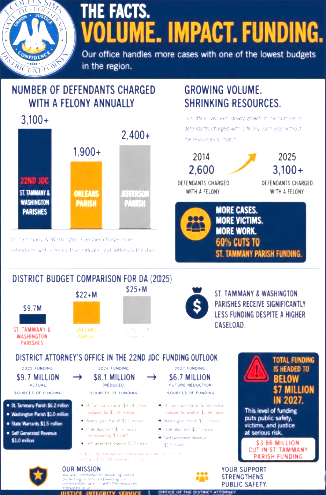
The graphic also states that the office faces a $3.86 million cut in St. Tammany Parish funding, which it describes as a 60 percent cut. In his interview with The Rabbit Hole, Sims described an expected additional reduction of about $1.86 million when the parish president submits the next budget. The Rabbit Hole has not independently verified the figures or projections in the graphic.
Because changing a dedicated tax is not like moving money between two checking accounts.
In many cases, voters approved the tax for a particular purpose.
“In all your dedicated funding, none of it can legally be moved, regardless of how much you save,” Sims said.
Changing that purpose can require additional legal steps and another vote.
Sims used St. Tammany’s fire districts as an example.
His point was not that fire departments should lose their funding.
His point was that even if everyone agreed tomorrow that the tax structure should be simplified, actually changing it could require numerous separate actions and votes.
Sims described a hypothetical attempt to restructure fire funding and said it could require separate votes across 14 districts.
He said even a single parishwide fire millage that kept the separate districts in place would still require those 14 separate votes, and if any one of them failed, the whole effort would fail.
The larger point was simple.
Restructuring an entire system of dedicated taxes cannot necessarily happen overnight.
St. Tammany Parish Government’s published figures show another major difference between St. Tammany and much of Louisiana.
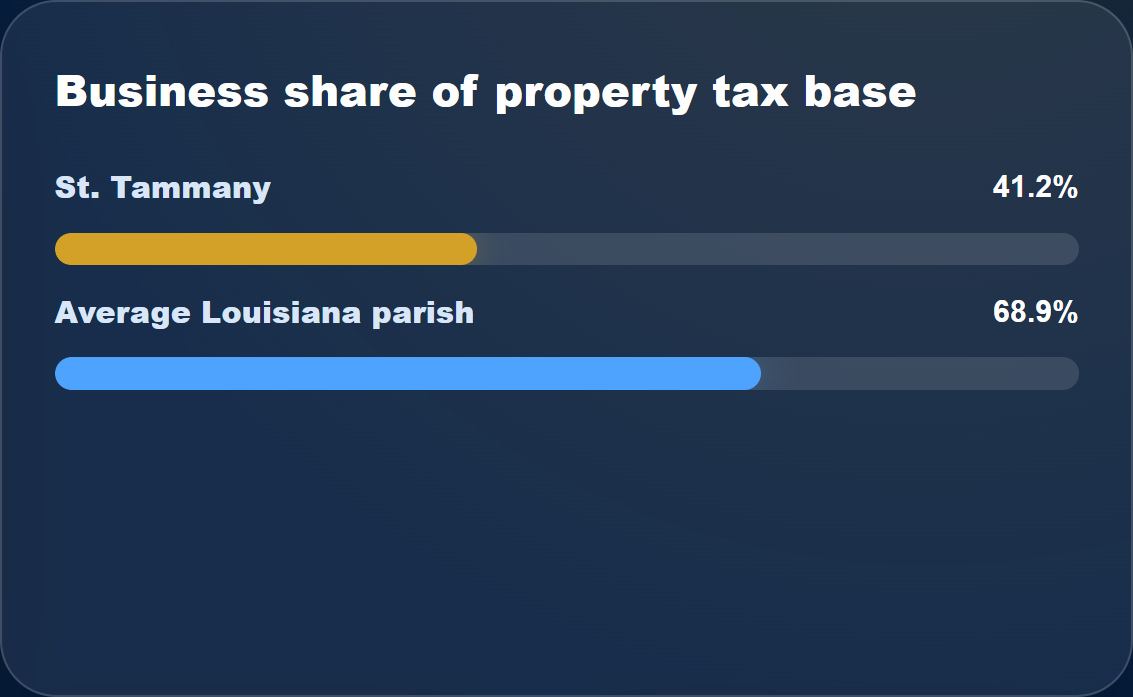
In 2024, businesses represented an estimated 41.2 percent of St. Tammany’s property tax base.
The estimated average Louisiana parish was 68.9 percent.
According to the parish’s published analysis, St. Tammany’s business property share was the lowest among Louisiana parishes.
In plain English:
St. Tammany relies more heavily on residential property than many other Louisiana parishes because businesses make up a smaller share of the property tax base.
This is important because Sims believes part of the long term solution is bringing the right kinds of businesses into St. Tammany.
More business property in the tax base can spread the property tax base across more commercial value instead of relying as heavily on residential property.
Sims said he does not want businesses that would change the character of St. Tammany, but said the parish has lost some businesses that moved elsewhere. Each time that happens, he said, more of the burden shifts to residents. He said the right businesses also bring good paying jobs.
That is Sims’s position on the long term problem.
The parish’s published numbers separately show that St. Tammany’s business share of its property tax base is considerably smaller than the statewide parish average.
The parish also published a comparison using a Louisiana Legislative Auditor comparison group and 2024 sales and property tax data.
The figures are:
The average for that comparison group was approximately $2,582.
St. Tammany was at $2,610.
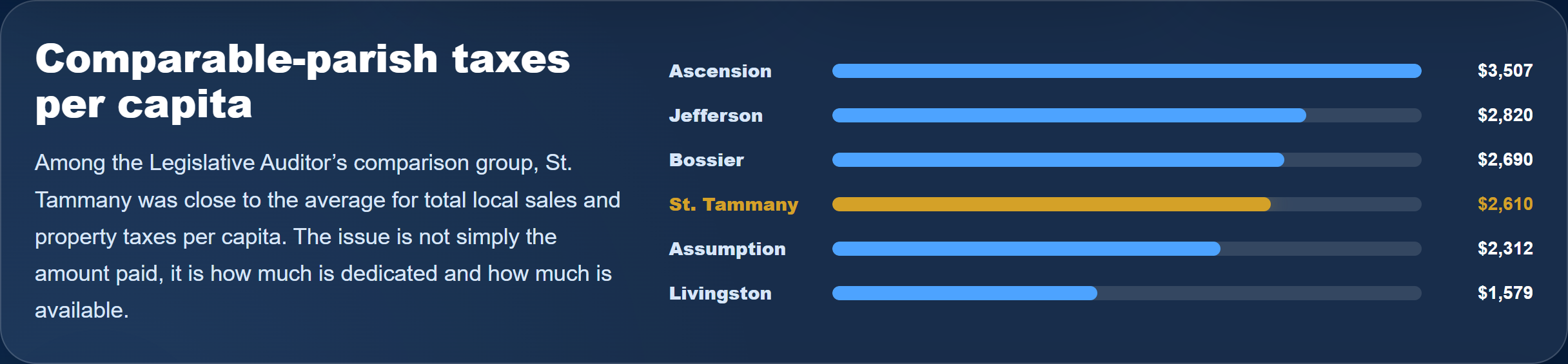
Important clarification: This does not mean St. Tammany ranks at a particular position among all 64 Louisiana parishes for taxes paid. This is a comparison among the specific parishes included in the Louisiana Legislative Auditor’s comparison group.
The purpose of this comparison is to provide context.
It does not settle whether an individual resident believes his or her taxes are too high.
The larger issue being discussed in this article is not simply how much money is collected.
It is also where that money is legally allowed to go once it is collected.
No.
And this was an important part of The Rabbit Hole’s conversation with Sims.
Sims discussed a much larger, long term restructuring of St. Tammany’s tax system.
When The Rabbit Hole asked what is supposed to happen during the five years, Sims said that in his opinion the period should be used for “some level of consolidation” of dedicated taxes, so agencies get “the collective savings of purchasing power” and other efficiencies.
The ideas Sims described included:
Sims said the five-year plan should also count reductions that have already been made. He listed a one mill cut to the extra drainage millage, a lower library millage and a partial reduction to the mosquito abatement millage, which he put at about $7 million combined.
He described the key question for taxpayers as whether a plan can be put in place that leaves them no worse off. “Can you make it be neutral to me?” he said. By the time the tax would come up for renewal, Sims said, the parish needs to be “in a position to reduce everything.”
Sims summarized what he sees as the larger problem by describing St. Tammany as having an older tax structure attempting to support a parish planning decades into the future. “How do you have a 2045 development plan in a 1985 tax structure?” he said.
He also discussed a separate idea he calls a “state mandated cost fund.”
That is NOT the quarter cent tax proposal currently before voters.
Sims described the idea as a possible future mechanism that could allow a limited portion of certain revenue to be placed into a restricted fund used only for costs that state law requires local government to provide.
As he described it, if the parish council voted to turn it on, 2 percent of what is collected would go into that fund. He said it should not be thought of as an emergency fund. It would be limited to state mandated costs, such as a children’s advocacy center like the Hope House, which he said the state requires but does not pay for.
He suggested capping the fund so that it could not simply accumulate money indefinitely. Under his idea, the fund could hold no more than one year’s worth of those bills, and it would have to shut off once it reached that amount.
Sims acknowledged that implementing his idea would require a constitutional amendment. He said it could be written for St. Tammany alone, but he would prefer a statewide version that lets each parish decide whether to use it.
So there are really two different conversations happening at the same time.
One is:
How do we pay the justice system’s bills now?
The other is:
How do we rebuild this tax structure so we are not having this same conversation again years from now?
Those questions should not be confused with each other.
Keeping the pieces straight:
Imagine you make enough money to pay all of your household bills.
But almost every dollar in your bank account is locked into a separate account.
One account can only pay your mortgage.
One can only buy food.
One can only pay electricity.
Then your car breaks down.
You technically have plenty of money.
But none of those accounts allow you to repair the car.
You now have two problems.
Problem one:
You need money to fix the car right now.
Problem two:
Your entire budgeting system may be too restrictive and may need to be redesigned.
That is the basic funding problem Sims described during his interview with The Rabbit Hole.
The proposed quarter cent sales tax is one proposed response to the immediate judicial funding problem.
The much larger question is whether and how St. Tammany should restructure its tax system over the long term.
People can look at the same numbers and disagree about whether the quarter cent sales tax is the right solution.
Someone can believe the justice system needs the money and still question whether a new tax is the right mechanism.
Someone else can believe the dedicated tax structure leaves the parish with too little flexibility and conclude that the quarter cent proposal is an appropriate temporary solution.
Those are decisions for voters.
Our job is to make sure readers understand what they are actually deciding.
Understanding the difference between money collected, money dedicated and money legally available is essential to understanding this debate.
Editor’s Note: The Rabbit Hole interviewed 22nd Judicial District Attorney Collin Sims for this report. Statements attributed to Sims are drawn from that interview. The parish financial graphics displayed in this article are provided by St. Tammany Parish Government and use the source years identified by the parish. One additional graphic comes from the Office of District Attorney Collin Sims, and its figures are those presented by that office. Details of the proposal are drawn from St. Tammany Parish Government’s published Tax & Financial Future Plan and a parish council resolution. Parish government figures and statements made by Sims have been identified separately throughout this article.






What do you think about this decision? What should local officials do next?
Free. Straight to your inbox. Cancel anytime.







Join the conversation — create a free TRH News account to comment.